
Business
What’s Next for School Leadership?
Discover how school leaders can turn new technology and Intelligent AI into better questions, earlier insights, smarter decisions, and meaningful action.


For decades, the Student Information System (SIS) has been the administrative backbone of schools—managing attendance, grades, records, and reporting.
Today, that role is changing.
As artificial intelligence becomes embedded into everyday school technology, the SIS is evolving from a record-keeping platform into the operational foundation of the modern school.
While much of the AI conversation focuses on classrooms and academic integrity, the biggest transformation is happening behind the scenes—in admissions, finance, communication, enrollment, and school operations.
The question is no longer "Should we use AI?"
It's "How should AI support our school's mission?"
Every major technology shift has changed how schools operate. The internet expanded access to information. Cloud software connected systems. Mobile technology transformed communication.
AI represents the next step—not as another application, but as intelligence embedded throughout the entire technology ecosystem.
Reporting is becoming predictive. Workflows are becoming automated. Communication is becoming smarter. Decision-making is becoming data-driven.
At the center of it all is the Student Information System, where the data that powers modern school operations already exists.
For years, schools solved challenges by purchasing another application—for admissions, communication, reporting, fundraising, or workflow management.
The result was often disconnected systems, duplicate work, fragmented data, and growing administrative complexity.
Today's schools need something different: connected platforms that automate routine work, surface meaningful insights, and allow information to flow seamlessly across departments.
Modernizing the SIS is no longer just a technology upgrade—it's an operational strategy.
The biggest challenge facing many schools isn't commitment—it's capacity.
Administrative teams are expected to communicate more, analyze more data, personalize experiences, and respond faster, often without additional staff.
AI helps by eliminating repetitive work, simplifying workflows, and delivering insights that support faster, better decisions.
Its greatest value isn't replacing people. It's giving educators and administrators more time to focus on students, families, and mission-critical work.
AI isn't simply a technology initiative. It's a leadership initiative.
The schools that succeed won't necessarily have the most software or the largest technology budgets. They'll have the clearest strategy for connecting people, processes, data, and technology.
School leaders should be asking:
These are strategic leadership questions—not technology questions.
Artificial intelligence is accelerating a shift that was already underway. Enrollment, communication, reporting, workflows, and decision-making are becoming increasingly connected, making the Student Information System far more than a back-office database.
The schools that thrive over the next decade will use AI to reduce complexity, strengthen communication, improve operational efficiency, and create more capacity for what matters most—serving students.
Schools don't just need an AI policy.
They need an AI strategy—one that aligns technology with their mission and positions them for the future.

Discover how school leaders can turn new technology and Intelligent AI into better questions, earlier insights, smarter decisions, and meaningful action.

Graphite is heading to Enroll 26 in San Diego! Connect with Marlena Turner and discover how one unified platform can help your school simplify operations, make smarter decisions, and give your team more time to focus on what matters most. Stop by the exhibit hall and say hello!
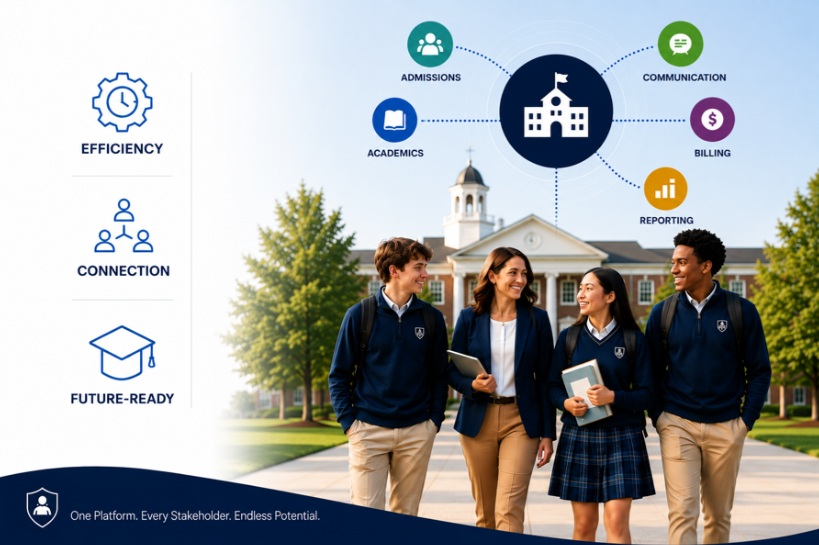
The Private School SIS Buyer’s Guide helps school leaders evaluate student information systems with confidence. Explore the capabilities that matter most—from connected operations and family experience to reporting, efficiency, and Intelligent AI—and discover the questions to ask when choosing a platform built to support your school’s future.

Discover why AI in education should help school leaders make better decisions—not just generate reports. Learn how AI-native SIS platforms improve school operations.

Graphite Education offers online software for managing school records, grades, schedules, admissions, and administrative tasks. Users access the software remotely, through a web browser via a recurring subscription fee. This eliminates local software installation and provides ongoing updates and support.
By subscribing you agree to with our Privacy Policy and provide consent to receive updates from our company.


