Why the Next Era of Education Technology Will Be Defined by Workflow Design, Automation, and Operational Intelligence
For years, schools have approached technology the same way: when a new challenge emerged, they purchased another application.
Enrollment required one platform. Communication required another. Student information, fundraising, admissions, reporting, and family engagement each introduced additional software.
The result? Many schools now manage dozens of disconnected systems that create duplicate work, fragmented data, inconsistent reporting, and unnecessary administrative complexity.
Ironically, more technology hasn't always made schools more efficient.
The Next Phase of Digital Transformation
Education is entering a new phase of digital transformation.
The conversation is shifting away from buying more software and toward designing better operations.
The question is no longer:
"What software do we need?"
It's becoming:
"How should work happen?"
This is a fundamental shift in how schools evaluate technology.
Instead of focusing solely on features, forward-thinking leaders are looking for technology that simplifies workflows, connects departments, eliminates manual processes, and helps staff accomplish more with less effort.
The schools that thrive over the next decade won't necessarily have the most software. They'll have the most connected and intelligent operations.
From Digitization to Operational Intelligence
The first generation of education technology digitized manual processes.
Paper forms became online forms. Reports became dashboards. Filing cabinets became databases.
Those advances were important—but they're no longer enough.
Today's AI-powered platforms can go much further.
Rather than simply storing information, they can identify trends, automate repetitive work, surface meaningful insights, and help school leaders make better decisions before problems become larger challenges.
Instead of asking:
- Which reports should we run?
- Which spreadsheet contains the answer?
Schools are beginning to ask:
- What work can be automated?
- Which students or families need attention now?
- Where are enrollment risks emerging?
- How can our staff spend more time serving students instead of managing software?
This is operational intelligence—the ability to transform school data into timely action.
Administrative Capacity Is Becoming a Competitive Advantage
Today's schools face growing expectations.
Families expect fast, personalized communication. Staff need efficient tools. Boards expect better reporting. Competition for enrollment continues to increase.
Yet administrative teams are often expected to deliver more without additional staff.
That's why operational efficiency has become a strategic advantage.
Technology should reduce complexity—not create it.
The right platform eliminates duplicate work, streamlines processes, and allows schools to scale without continually adding administrative overhead.
In the coming years, operational capacity may become just as important as enrollment strategy.
Connected Systems Create Better Outcomes
Schools often compare technology by individual features.
Increasingly, the real value comes from how well systems work together.
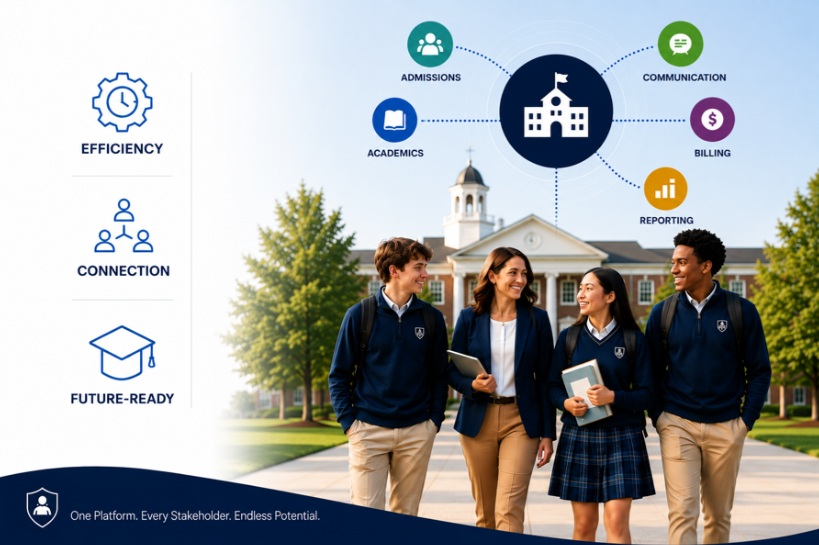
When student information, enrollment, communication, tuition, fundraising, and reporting operate on one connected platform, schools benefit from:
- Less duplicate data entry
- More accurate information
- Faster decision-making
- Better collaboration across departments
- A more consistent experience for families
- Greater operational efficiency
Instead of staff spending time moving information between systems, they can focus on supporting students, teachers, and families.
Educational Leadership Is Changing
Technology is no longer just an IT decision.
It has become a leadership strategy.
School leaders are increasingly evaluating technology based on its ability to improve organizational effectiveness—not simply add new functionality.
The institutions that connect workflows, automate routine tasks, and use AI to generate meaningful insights will be better positioned to strengthen enrollment, improve family engagement, support faculty, and deliver exceptional student experiences.
Operational excellence is becoming a competitive advantage.
Final Thoughts
The future of education technology will not be defined by how many applications a school owns, but by how intelligently those systems work together.
Schools that embrace workflow design, automation, artificial intelligence, and operational intelligence will spend less time managing software and more time advancing their mission.
Ultimately, the goal isn't simply better technology.
It's creating an organization that works smarter, responds faster, and gives educators more time to focus on what matters most—student success.