Why User Experience Matters in School Technology
How intuitive design improves adoption, engagement, and efficiency across the school community.


Every school leader understands the importance ofcommunication. Yet few realize how quickly communication has become one of themost significant operational, compliance, and trust-building challenges facingschools today.
Families expect immediate updates. Students communicatethrough multiple digital channels. Teachers are expected to be accessiblebeyond the classroom. Meanwhile, schools must navigate increasing expectationsaround student safety, transparency, and accountability.
The result is a new reality: school communication is nolonger just an administrative function. It is a strategic priority.
For years, educational leaders have focused on enrollmentgrowth, academic achievement, fundraising, and student outcomes. Thosepriorities remain essential. Yet another challenge is emerging that directlyimpacts every strategic initiative a school pursues: effective schoolcommunication.
From family engagement and parent communication toteacher-student communication and emergency notifications, today's schools aremanaging more communication than ever before. At the same time, digitalcommunication tools have fundamentally changed how educators, students, andfamilies interact.
While these technologies offer significant benefits, theyalso introduce new responsibilities. School leaders must now balance studentsafety, educator protection, compliance requirements, and community trust inways that previous generations never faced.
Recent legislation in states such as Kentucky has broughtnational attention to the growing need for transparent and accountable schoolcommunication practices. While these efforts often focus on electroniccommunication between educators and students, the broader conversation extendsfar beyond any single state or regulation.
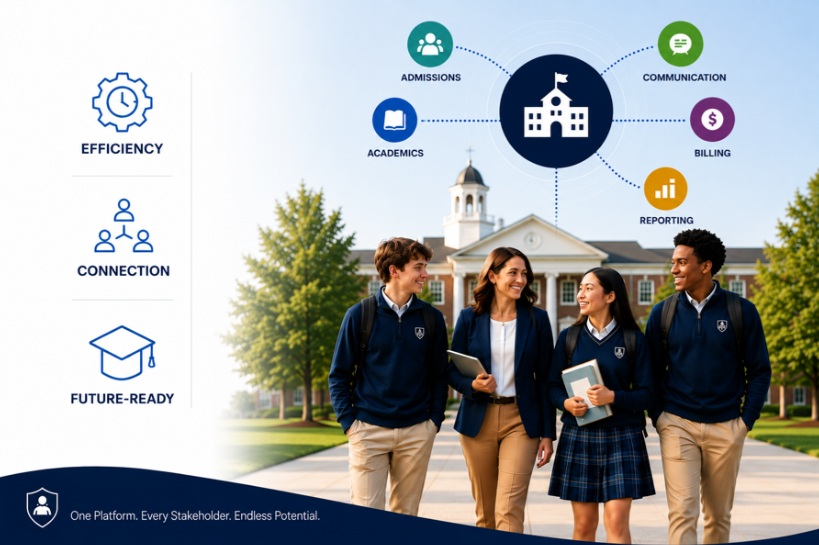
Increasingly, school leaders are discovering thatcommunication challenges are not solely policy issues. They are oftentechnology issues as well. School communication, student records, enrollmentmanagement, attendance, parent engagement, and family engagement are deeplyinterconnected, making the Student Information System (SIS) a criticalcomponent of any long-term communication strategy. As K-12 schools continue tomodernize their operations, educational leaders are looking for educationtechnology solutions that connect communication, student informationmanagement, and school operations management within a unified platform.
The question educational leaders should be asking is notsimply whether they are compliant.
The question is whether their communication policies,technology systems, and operational practices are designed to protect everyoneinvolved while creating a seamless experience for staff, students, andfamilies.
Why School Communication Has Become a Strategic Priority
Communication is no longer simply an administrativefunction. It has become a strategic driver of school success.
Every interaction between a school and its stakeholdersinfluences perception, trust, engagement, and retention. Whether communicatingwith prospective families, current parents, students, faculty, or alumni,schools are expected to deliver timely, accurate, and personalized experiences.
Research consistently shows that strong school-familycommunication contributes to improved student achievement, higher attendancerates, stronger family engagement, and increased student retention. Schoolsthat communicate effectively build stronger relationships with theircommunities and create greater confidence among families.
"School communication is no longer just anadministrative function. It has become a strategic driver of enrollment,engagement, operational efficiency, and trust."
Effective school communication supports:
As expectations continue to rise, many schools findthemselves managing communication across email, text messaging, mobileapplications, parent portals, social media platforms, learning managementsystems, and student information systems.
The challenge is not the volume of communication.
The challenge is maintaining consistency, transparency, andaccountability across every channel.
The rise of digital communication has created tremendousopportunities for schools to strengthen relationships and improveresponsiveness. However, it has also introduced new operational andreputational risks.
Teachers, coaches, advisors, and administrators regularlycommunicate with students and families outside traditional school hours.Without clear school communication policies and approved communicationchannels, these interactions can create unintended challenges.
Potential risks include:
The objective is not to limit positive relationships betweeneducators and students.
The objective is to create communication environments thatprotect students, support educators, and strengthen trust.
When discussions about school communication policies arise,the focus often centers on student safety—and rightly so.
However, strong communication policies also provide criticalprotection for educators.
Teachers today face increasing expectations foraccessibility and responsiveness. Students seek support beyond classroom hours.Families expect prompt communication. Coaches and advisors frequentlycoordinate schedules, activities, and events.
Without clear communication standards, even well-intentionedinteractions can expose educators to unnecessary risk.
When communication occurs through approved schoolcommunication platforms, educators benefit from:
Transparency protects students.
Transparency also protects teachers.
The strongest communication strategies recognize that bothobjectives are interconnected.
Best Practices for Teacher-Student Communication
As digital communication becomes more prevalent across K-12education, schools should establish clear expectations for teacher-studentcommunication.
Leading schools are implementing practices that include:
These best practices help create safer environments whilesupporting meaningful educational relationships.
Most importantly, they provide educators with confidencethat they are operating within clearly defined professional boundaries.
Policies alone are not enough.
Technology plays an equally important role in creatingeffective communication systems.
Many schools continue to rely on disconnected tools formessaging, attendance, student records, parent communication, enrollmentmanagement, and administrative processes. The result is often inefficiency,duplicated effort, fragmented data, and inconsistent experiences for families.
A modern school communication platform should provide:
Technology should make compliance easier, not morecomplicated.
For many schools, that starts with evaluating whether theirStudent Information System (SIS) supports modern communication expectations.When communication tools operate separately from student records, attendancedata, enrollment management systems, and parent portals, schools often createunnecessary administrative work and increase the likelihood of communicationgaps.
A modern SIS should serve as more than a student database.It should function as a central hub that supports student informationmanagement, school communication, family engagement, and school operationsmanagement. Increasingly, schools are looking for school management softwareand school administration software that can unify these functions within asingle platform.
The most effective communication systems create transparencywhile reducing administrative burden for staff.
Effective communication is no longer separate from schooloperations. It influences enrollment management, family engagement, studentretention, and administrative efficiency.
Schools that rely on disconnected systems often createadditional work for staff while delivering inconsistent experiences forfamilies. Communication becomes fragmented, records become harder to manage,and administrators spend valuable time reconciling information across multipleplatforms.
By integrating communication within a modern StudentInformation System (SIS), schools can streamline operations, improvevisibility, reduce administrative burden, and create a more connectedexperience for everyone involved.
As schools face growing expectations with limited resources,administrative efficiency is becoming a competitive advantage. The ability tocommunicate effectively while simplifying workflows allows schools to focusmore time on students, families, and strategic initiatives. For many K-12schools, effective school operations management is becoming just as importantas academic performance and enrollment growth.
The Student Information System (SIS) has become one of themost important education technology investments a school can make.
Historically, SIS platforms were designed primarily tomanage attendance, grading, scheduling, transcripts, and student records.Today, educational leaders increasingly expect their SIS to play a much largerrole in school communication, family engagement, enrollment management, studentinformation management, school operations management, and administrativeefficiency.
A modern SIS helps schools centralize communication byconnecting critical functions such as:
When communication tools are integrated into a school's SIS,schools benefit from a single source of truth. Administrators gain greatervisibility, teachers spend less time managing multiple systems, and familiesenjoy a more consistent experience.
The result is not only better communication but alsostronger operational efficiency across the institution.
As communication requirements continue to grow, schools thatrely on disconnected systems often face increased administrative burden,inconsistent messaging, and fragmented family engagement.
As competition for students increases, operationalefficiency is becoming just as important to long-term success as enrollmentstrategy itself. Schools that streamline communication through integrated SISplatforms are better positioned to meet rising expectations without increasingadministrative workload.
The most effective schools are moving toward integratedschool management software and SIS solutions that bring communication,operations, enrollment, and student data together into a unified ecosystem.
This shift is not simply a technology upgrade. It is astrategic investment in the school experience for students, families, faculty,and administrators alike.
The most successful schools understand that communication isultimately about trust.
Families want visibility.
Educators want clarity.
Students need support.
Administrators require accountability.
Strong school communication policies help schools achieveall four objectives simultaneously.
The institutions that will thrive in the coming years willnot necessarily be those with the most communication tools. They will be theschools that create intentional communication strategies supported by clearpolicies, modern technology, and strong leadership.
Schools across the country are reexamining how communicationshould occur in an increasingly digital environment. While compliance remainsimportant, the larger opportunity lies in building communication systems thatstrengthen relationships while reducing risk.
The future of school communication is not about restrictingconnections between educators and students.
It is about creating transparent, secure, and accountablecommunication environments where those relationships can thrive.
For many schools, communication has become the new frontdoor of the school experience. Families often form opinions aboutresponsiveness, transparency, and professionalism long before they visit acampus or complete an application. In that sense, communication is no longersimply a support function—it is a reflection of institutional effectiveness.
The schools that lead in the next decade will not be thosethat simply communicate more. They will be the schools that communicate withgreater transparency, consistency, and purpose.
When communication policies, education technology, schooloperations, and administrative processes work together, schools create saferenvironments, stronger relationships, improved family engagement, and moreefficient operations.
Students are protected.
Educators are supported.
Families are engaged.
And schools are better equipped to fulfill their mission.
Schools evaluating their communication strategy should alsoassess whether their Student Information System and operational technology arehelping—or hindering—their ability to engage families, support educators,streamline administration, and strengthen the overall school experience.
Lorem ipsum dolor sit amet, consectetur adipiscing elit.