Why User Experience Matters in School Technology
How intuitive design improves adoption, engagement, and efficiency across the school community.


For years, schools facing enrollment challenges have reachedfor the same solution: more marketing.
More advertising. More social media. More open houses. Morecampaigns.
And while marketing matters, a growing number of schools arediscovering a difficult truth:
You can't market your way out of operational problems.
As the much-discussed enrollment cliff approaches, schoolswill face increasing competition for every student and family. Demographicshifts, declining birth rates, expanded school choice options, and changingparent expectations are creating a new reality.
The schools that thrive won't simply be the schools with thebiggest marketing budgets. They will be the schools that have invested inmodern school operations, strong family experiences, and the systems thatsupport long-term growth.
Families today evaluate schools differently than they dideven five years ago.
They're asking questions like:
In other words, families are judging the entireexperience—not just the academic program. Behind that experience are theprocesses, communication tools, and school management software that supportdaily school operations.
And that experience is largely driven by operations.
Think about the journey a prospective family takes.
A parent submits an inquiry.
How long does it take to receive aresponse?
They request information.
Is it easy to find?
They begin enrollment.
Is the process simple, or does itrequire multiple forms, emails, and follow-up calls?
Every delay, confusing process, and communication breakdowncreates friction that can negatively impact both enrollment and enrollmentretention.
And in a competitive enrollment environment, frictiondrives families elsewhere.
The strongest schools are focusing on more than recruitment.
They're investing in:
Better Communication
Families expect timely, personalized communication acrossmultiple channels.
Better Processes
Enrollment, registration, scheduling, and family engagementshould be simple, intuitive, and efficient.
Better Technology
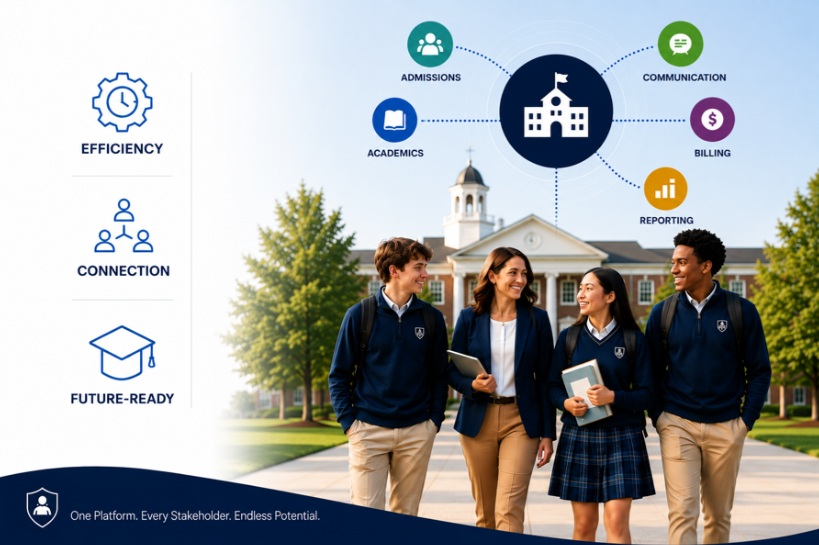
Technology should reduce administrative burden—not createmore work. A modern student information system, integrated communication tools,and purpose-built SIS software can help schools streamline workflows, improvedata visibility, and create a better experience for families.
Better Data
Leaders need visibility into enrollment trends, familyengagement, and operational performance. Effective school data managementallows leaders to make faster, more informed decisions while identifyingopportunities to improve enrollment outcomes.
When these elements work together, schools create a betterexperience for everyone:
Ø Students
Ø Families
Ø Teachers
Ø Administrators
One of the biggest challenges facing schools today isn'ttechnology.
It's time.
Across K-12 administration, leaders are being asked to domore with the same—or fewer—resources.
Meanwhile, staff are stretched thin managing enrollment,communication, reporting, compliance, and daily operations.
The schools that succeed over the next decade will find waysto increase administrative capacity without increasing complexity.
That's where school operational efficiency becomes astrategic advantage.
Not because it's flashy.
Because it works.
The enrollment cliff isn't simply an enrollment challenge.
It's an operational challenge.
Schools that create efficient systems, streamlinecommunication, and eliminate unnecessary administrative work will be betterpositioned to attract and retain families.
The future of K-12 operations will belong to schools thatcombine strong leadership with effective technology and well-designedprocesses.
Because when families compare schools, they aren't onlyevaluating what you teach.
They're evaluating how your school works.
And increasingly, that experience matters.
The enrollment cliff is often discussed as a demographicchallenge, but the schools that navigate it most successfully will recognize itas a leadership opportunity.
This moment calls for more than new marketing campaigns oradditional software. It requires a thoughtful examination of how schoolsoperate, communicate, and serve their communities. The institutions thatemerge stronger will be those that remove friction, strengthen relationships,and create exceptional experiences for students, families, and staff.
At Graphite Education, we believe technology is only part ofthe equation. Sustainable success comes from aligning people, processes, andsystems around a shared mission. That alignment requires a clear schooltechnology strategy that supports operational goals, family engagement, andlong-term growth.
That's why we work alongside school leaders as strategicpartners—helping them evaluate challenges, identify opportunities, and buildoperational foundations that support long-term success.
The future belongs to schools that are agile, connected,and prepared to adapt. As enrollment pressures continue to reshapeeducation, operational excellence will no longer be a back-office function—itwill become a defining characteristic of high-performing schools.
The enrollment cliff is coming. But for schools willingto invest in stronger operations, smarter technology strategies, and betterexperiences, it may also become a catalyst for transformation.
Graphite Education is committed to helpingschools navigate that journey—not as a vendor, but as a trusted partner inbuilding the future of school operations.
Lorem ipsum dolor sit amet, consectetur adipiscing elit.